The Real Cost of Buying a Home: More Than Just the Down Payment
Quick answer
Buying a home costs more than just the down payment. Here are the three buckets of money every buyer needs to understand.
REALTOR® with RE/MAX Journey and Mortgage Loan Originator, NMLS #2603041. Bilingual homeownership education with a local focus on Rutherford County and Western North Carolina.
The Real Cost of Buying a Home: More Than Just the Down Payment
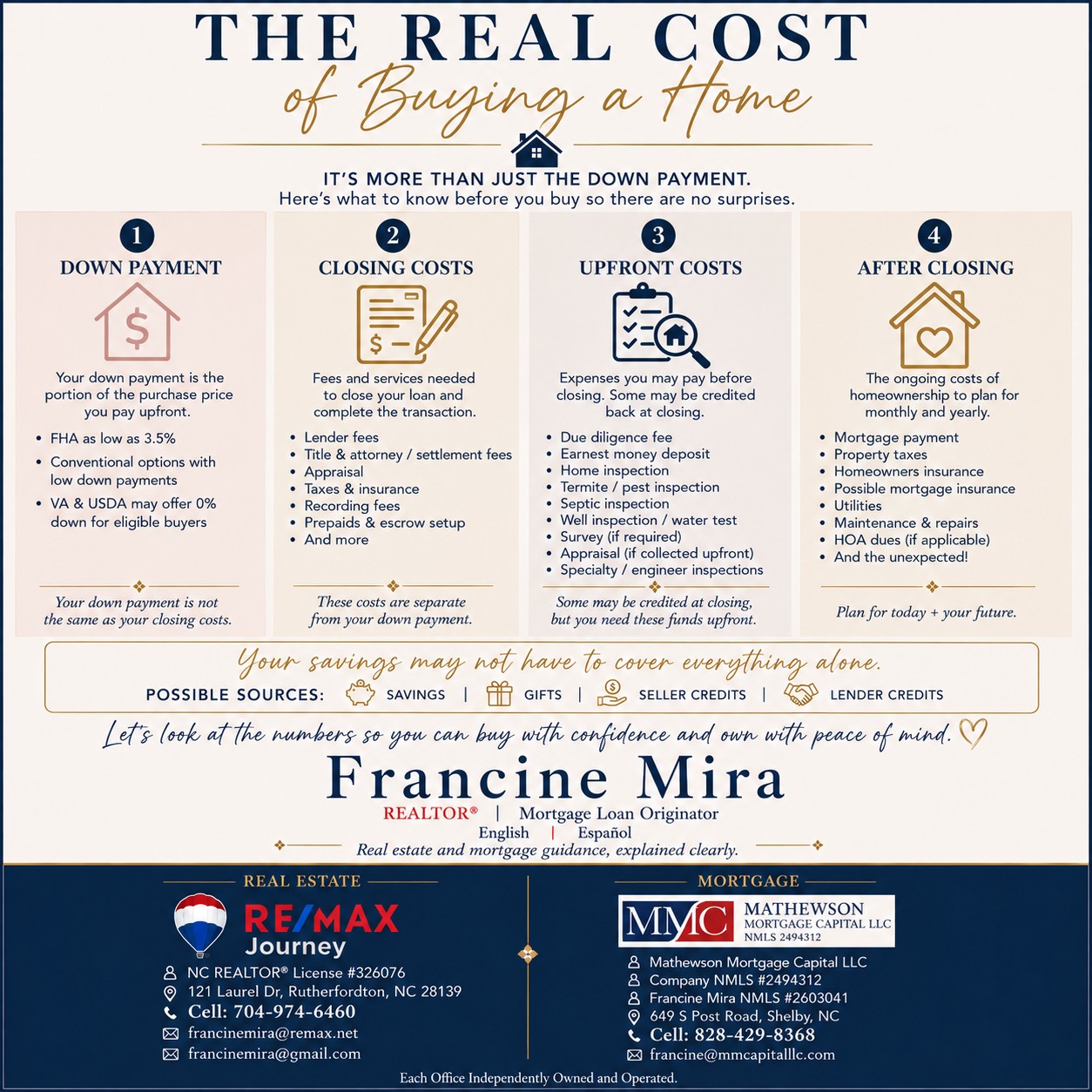
Buying a home costs more than just the down payment.
And this is probably one of the biggest surprises for first-time buyers.
When someone asks me:
"How much money do I need to buy a house?"
The answer is not just:
"3.5% down."
There are really THREE different buckets of money we need to talk about.
1. Down Payment
Your down payment is the portion of the purchase price you are putting toward the home instead of financing.
Examples:
- FHA may allow a qualifying borrower to purchase with a relatively low down payment.
- Some Conventional programs may allow low down payments.
- Eligible VA and USDA borrowers may have no-traditional-down-payment options.
But that does NOT mean there are zero costs involved.
Your down payment is only one piece of the puzzle.
2. Closing Costs
Closing costs are the expenses involved in creating, processing, insuring, and closing the loan and real estate transaction.
Depending on the transaction, they may include things like:
- Lender fees
- Attorney and settlement fees
- Title work
- Recording fees
- Credit report
- Appraisal
- Prepaid homeowners insurance
- Property taxes and escrow setup
- Discount points, if applicable
- Other loan or property-related charges
These costs are separate from your down payment.
And here is where planning the transaction correctly can make a BIG difference.
Who can potentially help with closing costs?
Depending on the loan program and transaction:
- The seller may be able to provide a negotiated seller credit within program limits.
- A lender credit may sometimes be available, generally tied to the pricing or interest-rate structure of the loan.
- Eligible gift funds may be available from an acceptable donor with proper documentation.
- Certain approved assistance programs may be available when both the buyer and lender have access and the transaction meets the program rules.
Important: A normal seller closing-cost credit generally does not become your down payment. They are different parts of the transaction.
3. The Upfront Costs People Forget About
This is the money you may spend before you ever get to the closing table.
In North Carolina, that can include:
- Due diligence fee
- Earnest money deposit
- Home inspection
- Termite or pest inspection, if needed
- Septic inspection
- Well inspection or water testing
- Survey, depending on the transaction
- Appraisal, depending on how the lender collects the fee
- Specialty inspections if something is discovered
- Engineer or foundation inspections on certain properties
Some of these costs may ultimately be credited within the transaction if the purchase closes, while others are simply expenses of investigating and financing the property. Buyers should understand which funds are refundable, creditable, or at risk before paying them.
What About Down-Payment Assistance in North Carolina?
Down-payment-assistance programs may exist for some North Carolina buyers, but not every program is available through every lender.
That distinction matters.
A program can exist in North Carolina and still not be accessible through the lender handling your mortgage. Because I originate through Mathewson Mortgage Capital LLC, I only want buyers building their financing plan around assistance that is actually available through Mathewson for their transaction.
So the sequence should be:
- Review your borrower profile and first-mortgage options.
- Confirm which assistance programs, if any, Mathewson currently has access to.
- Review eligibility, repayment terms, liens, fees, and cash-to-close impact.
- Only then build the purchase strategy around an assistance amount.
For that reason, FrancineMira.com does not advertise a specific state assistance program as a Francine/Mathewson option unless access has been confirmed.
"I Don't Have 20% Down, So I Can't Buy."
When somebody tells me:
"I don't have 20% down, so I can't buy."
My response is:
"Let's actually look at the numbers first."
Depending on the loan and your eligibility, the funds for a transaction could potentially involve a combination of:
- Your own savings
- Eligible gift funds
- An accessible down-payment-assistance program
- Seller-paid allowable closing costs
- Lender credits
- The right loan structure
The exact combination depends on your loan, income, credit, property, available funds, and current program access.
The True Cost of Homeownership Doesn't Stop at Closing
Once you own the home, your budget also needs room for:
- Mortgage payment
- Property taxes
- Homeowners insurance
- Possible mortgage insurance
- Utilities
- Maintenance
- Repairs
- HOA dues, if applicable
- Septic or well maintenance, if applicable
- And the occasional "Why is the water heater making THAT noise?" expense.
That is why I do not want to just get somebody approved. I want buyers to understand the whole picture.
The goal is not just:
"Can I close on this house?"
The better question is:
"Can I comfortably own this house after closing?"
Those are two very different questions.
If you are thinking about buying in North Carolina, even if you are not sure you have enough saved yet, start with the numbers before you count yourself out.
See the North Carolina Down Payment Assistance Guide or Mortgage Pre-Approval Guide for the next step.
Francine Mira | Mortgage Loan Originator
Mathewson Mortgage Capital LLC
Company NMLS #2494312
Francine Mira NMLS #2603041
828-429-8368
francine@mmcapitalllc.com
Francine Mira | REALTOR®
RE/MAX Journey
NC REALTOR® License #326076
704-974-6460
francinemira@remax.net
Real estate and mortgage services are separate professional roles. Mortgage information is educational and is not a commitment to lend or guarantee of approval. Program availability, assistance, eligibility, and lender access can change.
Want to see what you could qualify for?
Stop guessing. Check your readiness and, when you are ready, continue into the secure mortgage pre-approval process.